by Luke
This past winter and spring, A Rocha has run a monthly series of Wednesday night “talks” at both our Brooksdale Environmental Centre in Surrey, BC and in the Pembina Valley of Manitoba. The goal of both series has been to highlight the lives of folks who are living out an ethos in various contexts and circumstances, that matches A Rocha’s, giving the speakers a platform to share their own journey and their work.
The Brooksdale Series included:
- Steven Gnam, who presented an evening of conservation photography
- Rob and Ruth des Cotes, Brooksdale’s resident hosts, who shared about their Pilgrimage on the Camino de Santiago
- Rowenna Gryba, a Marine Biologist specializing in marine mammals
- John Mackenzie, President of Anita’s Organic Mill
- Mike Yankoski, author and activist who shared his journey to creation care
The Manitoba Series included:
- Bill Stilwell, an author and photographer who introduced his audience to “Manitoba Wild”
- Ruth Hiebert, a nature photographer who presented the “Art of Seeing Beauty Everywhere”
- Alex Scharf, an agriculturalist specializing in greenhouse gardening in Manitoba’s native communities in the extreme north
- Dr. Sheila Forsyth, a senior staff scientist with Friends of the Earth who has conducting the “Be True to Blue” research project studying water conservation issues in the Pembina Valley
This item currently has no responses.
by Luke
Come lend a hand, find the perfect native plant for your garden and then enjoy a free, local meal!
Join us rain or shine Saturday, May 12th to help with special projects at A Rocha’s Brooksdale Environmental Centre. Our native plant nursery will also be stocked with new and colourful plants for sale for the gardening season (read more).
10:00am – Work begins
12:30pm – A Rocha Centre tour
1:00pm – Free lunch for volunteers
2:30pm – Native plant sale ends
To RSVP or arrange for large groups, please email british.columbia@arocha.ca or call 604.542.9006
Please enjoy browsing the newly renovated River Tree Store! Also, special offer discount on plantable wildflower seed coasters (0.50 cents each).
This item currently has no responses.
by Luke
A Rocha is participating in the Surrey’s Great Salmon Run – a way to raise awareness and resources for conservation work in Surrey.
We are encouraging friends of A Rocha to run for the cause of conservation in Surrey. You can even get pledges for your run and the money goes directly to A Rocha. You can register & pledge below.

The goals of the “Great Salmon Run” are to increase community awareness, participation and support in Surrey’s volunteer organizations and to spark an interest in the general public to interact with and care for the watersheds that they reside within. “Surrey’s Great Salmon Run will bring the community together in Tynehead Regional Park to celebrate our freshwater fish habitat and our volunteer supporters that we’re so fortunate to have in our city,” says Mayor Dianne Watts.
How you can help:
Support Your Salmon Stewards – Register Today!
For more information on the run and the Salmon Stewardship Groups it supports, please visit www.surrey.ca/greatsalmonrun
Event Day Schedule
9:15am – Shuttle service from North Surrey Secondary starts**
9:30am – Package Pickup / Late Registration Open
10:30am – 5km / 8km events start
11:30am – Kids’ Dash ‘n Splash starts
11:00am – BBQ starts
10:00am-3:00pm – Activities for runners and public
3:30pm – Shuttle service back to North Surrey Secondary ends**
**North Surrey Secondary is located at 96 Ave and 160 St
All event info located on the City of Surrey’s website (Click here).
Use code rocha-5off for $5 off!
This item currently has no responses.
by Dezene
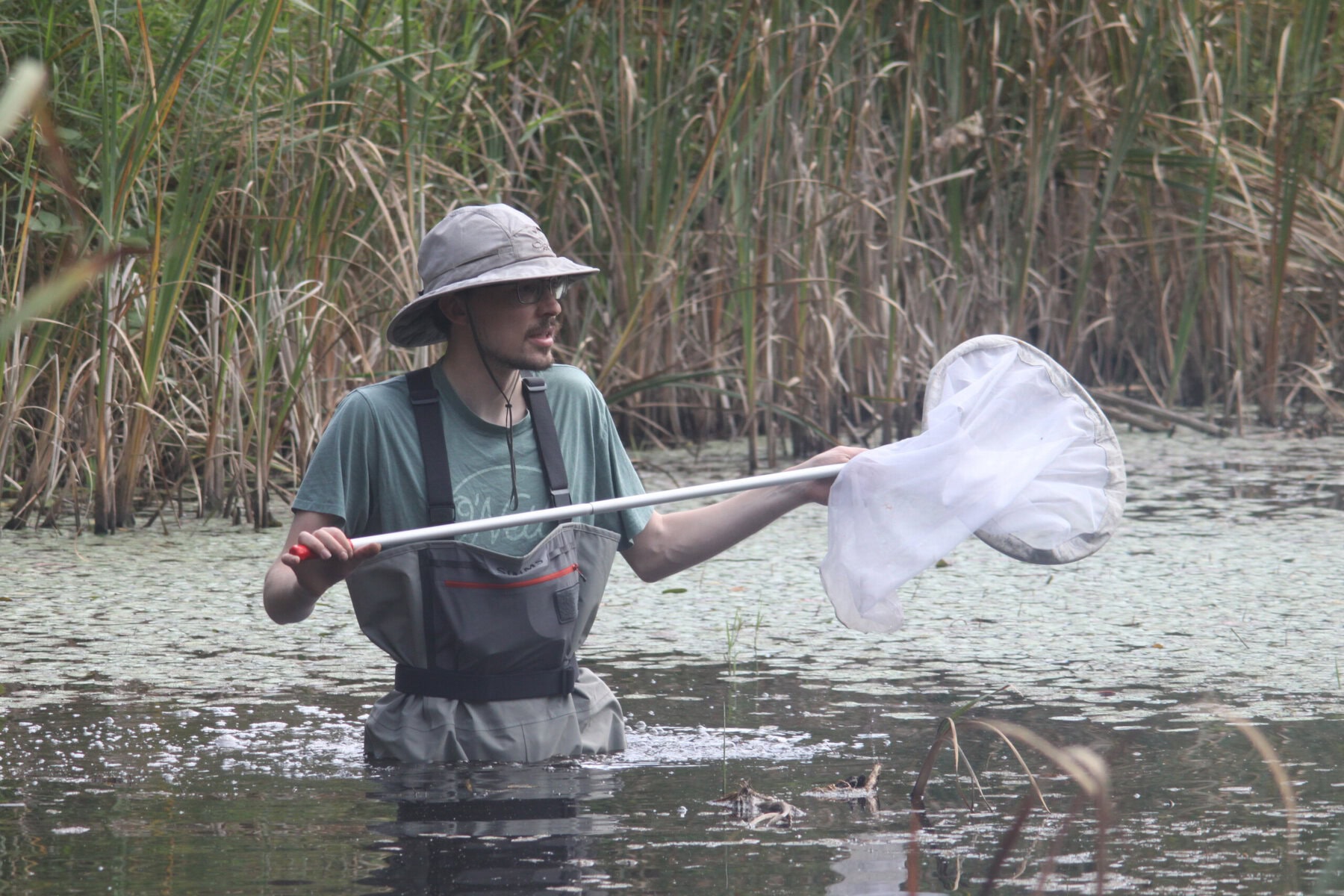
Over the past few weeks, the A Rocha Conservation Science team has been surveying ponds throughout the Little Campbell River watershed for northern red-legged frog eggs.
Why do we survey for eggs and not the adult frogs themselves? Because the adults quickly dive down into the vegetation and litter at the bottom of the ponds at the first sign of being approached. Their large egg masses, however, are usually at or near the surface of the water, attached to woody debris or aquatic plants. Egg masses are the best indicator of a healthy and reproducing population. Of course, eggs soon hatch into tadpoles, so the window of opportunity for these surveys is short. So, it’s been a flurry of activity lately!
A Rocha team members have been surveying ponds in the area for northern red-legged frogs every spring since 2009. Along with counting egg masses, we have also been collecting habitat and water quality information. The growing dataset has begun to allow us to monitor shifts in the health of the local population of this threatened species.
This item currently has no responses.
by Luke
Are you excited about following Christ and caring for creation? The Earthkeeping Institutes are a chance to learn more and go deeper! Join us for a weekend of biblical teaching, discussion, sharing meals, and hands-on environmental stewardship. Bring home a new perspective and new practices to care for creation in your own backyard.
July 6 – 9, 2012
This summer’s Earthkeeping Institute offers four full days of exploring diverse ways in which food links us to Creation and to the life of faith. Theory and praxis will come together as we go from morning bible studies into the garden to get our hands dirty and into the kitchen to prepare meals together. Participants will engage with all aspects of ‘food’ during the course – growing, weeding, harvesting, preparing, cooking, and most vitally – enjoying! We will explore not only the theological and practical but also the social, cultural, historical, and agricultural dimensions of food. Join us as we learn to live more faithfully as good stewards of our food.
(Includes 3 nights of accommodation, 4 days of garden-fresh meals, teaching, hands on activities, time for reflection, and an unforgettable experience)
Guest House: $450 (for shared accommodation in the guesthouse – space is limited)
Camping: $375 (participants will provide their own camping equipment)
Commuter: $300 (does not include accommodation)
A Rocha’s Brooksdale Environmental Centre is a beautiful heritage estate made up of pasture, gardens, and trails alongside the Little Campbell River. It’s a unique setting that makes for a restorative and unforgettable experience. For information and photos please browse our website and Click here for address and map.
Click here to be taken to a registration page. Online payment should be made upon registration online or call 604.542.9022 to pay by phone or email us if you are mailing in a cheque.

October 26 – 28, 2012
Our Fall Earthkeeping Institute will highlight some of the ongoing work of A Rocha in the Little Campbell River Watershed to protect species at risk within the wider framework of global biodiversity. We are called to care for the diversity of our local ecology within the context of a biblical framework of God’s love and care for all creation. Participants will spend the weekend in our guesthouse participating in morning bible studies, spending afternoons exploring the watershed and enjoying community meals in between.
Includes 2 nights of accommodation, garden-fresh meals, teaching, hands on activities, time for reflection, and a great experience
Guest House: $350 (for shared accommodation)
Commuter: $250
A Rocha’s Brooksdale Environmental Centre is a beautiful heritage estate made up of pasture, gardens, and trails alongside the Little Campbell River. It’s a unique setting that makes for a restorative and unforgettable experience. For information and photos please browse our website and Click here for address and map.
Click here to be taken to a registration page. Online payment should be made upon registration online or call 604.542.9022 to pay by phone or email us if you are mailing in a cheque.
This item currently has no responses.
by Peter Scholtens
Originally posted on the New City Church blog.
I love Easter. It’s one of my favourite times of the year. It’s spring, which helps with the celebratory feeling. Winter has lost its grip on the world around us. Flowers are blooming, birds begin singing, and warm breezes play across my face, but more importantly, and most of all, Easter is a time when we celebrate Jesus’ resurrection. When Jesus died and then rose from the dead, He made all things right– He reconciled all things to himself (Colossians 1:19). Praise Him!
What are the implications of reconciliation? Our tendency is to focus on the reconciliation between God and humanity. But Scripture teaches us that there is so much more. Jesus came for a rescue mission. That mission was to save all of creation. That is the gospel; that Jesus died for all of creation. As humans, we become part of the rescued by believing in him. Creation desires and looks forward to being rescued, and has been doing so for a long time.
The desire of creation for restoration is woven into the Old Testament. For example, consider the closing words of Psalm 96.
Let the heavens be glad, and let the earth rejoice;
let the sea roar, and all that fills it;
let the field exult, and everything in it!
Then shall all the trees of the forest sing for joy
before the LORD, for he comes,
for he comes to judge the earth.
He will judge the world in righteousness,
and the peoples in his faithfulness.
Imagine the roar of the sea, or here in Ontario, the roar of the waves on the Great Lakes. In the rushing of the waves churning on the beach, and in the wind sweeping through the tree tops, the psalmist heard creation calling for his Lord to come, and to bring His justice.
Why is creation experiencing injustice? Creation is experiencing injustice because of our sin. That’s true in a couple of different ways. Most obviously, we harm creation in our our greed and pursuit of selfish gain.
When we live in Hamilton, it’s easy to see and smell the injustice. The industrial areas in the north end are built on former wetlands that have been filled in. The air in the North end of the city is charged with the smells of industry. Migrating and resident waterfowl and wading birds feed in sediment that is polluted with toxins. Streams flowing into the harbour and Cootes Paradise are contaminated with sewage.
However, we also know from Paul’s in Romans 8 that our sin had cosmic effects. Creation groans, subject to pain and frustration until that final day. We can see this in natural disasters such as tsunamis and hurricanes that not only cause great loss of human life, but also much suffering to the rest of creation. In addition, I believe that we see this in certain organisms whose very existence and life cycle causes pain and suffering, including the tiny organisms that cause malaria. Because creation needs restoration, it wants renewal. It looks forward to release from that pain.
We feel the pain that creation feels as well. Our relationship as humans with the rest of creation is broken. We see how much the greed, selfishness, and carelessness of humans disrupts and destroys the rest of creation. Second, we struggle with the brokenness in human relationships, as we deal with tension within our marriages and families. Different sectors of society battle with each other for funding, for space, and for power. At the worst of times, nation wars against nation.
Worst of all, our relationship with God is broken. The Fall into sin broke us so badly that, no matter how hard we try, we are not able to keep His laws. We keep running against the boundaries that were made when He first put creation together. We are distant from God, not knowing how to serve Him or how to walk in the paths that He placed within creation.
But there is hope. When Christ comes into our lives, He brings renewal and restoration to all our relationships.
First, our relationship with God is restored and renewed. Faith in Christ brings His grace into our lives. The distance between us and God is removed. Through His Word and the guidance of the Spirit, as we grow in faith, we learn to love Him, follow Him, and walk in His ways. The paths that He laid out for us in creation become more clear. We begin to be able to walk in His ways.
Second, when Jesus’ kingdom enters our lives, we see a beginning of renewal of our relationships with our neighbours. We begin to see and appreciate them as His image bearers, worthy of our love and care. We desire what’s best for others, not just for ourselves, seeking their good, striving for justice in their lives.
Third, when the kingdom comes, it also begins to bring renewal and restoration of our relationship with the rest of creation. When we become part of Christ’s kingdom of reconciliation, we begin to appreciate creation as the unique artistry of the One who made it all. It is also the womb in which He gives us our physical nourishment, and the place where humanity lives and moves.
Christ’s entering our lives brings a lot of new beginnings. The work is slow, but the progress is sure. However, we will never see perfection on this side of glory. It is not until Christ’s final return that all things will be made new again. Creation will continue to groan, we will experience and cause pain, and we will not be able to live lives of wholeness until that Day.
However, we do have reassurance that the Day will come. It’s called Easter! The great thing about the Resurrection, and the reason we celebrate it, its that it’s a sign of the new creation that will come to all things. Christ’s new body is a first fruit of the recreation that will come to all things (1 Corinthians 15:23). It’s a reassurance, a sign of what’s possible, a deposit, a promise of what will be for all creation.
This is what we celebrate at Easter! We rejoice in the reconciliation that Jesus Christ brought and will bring to all our relationships, bringing our praises along with the trees, singing with the mountains and hills (Isaiah 55:12).
This is good news. It’s good new for all of creation. So let’s do as Jesus asked and “go into all the world and proclaim the gospel to the whole creation” (Mark 16:15). It’s only in this gospel that reconciliation and recreation comes. It’s only in this gospel that creation has hope. Let’s rejoice in its impact on every part of creation!
This item currently has no responses.
by Dezene
Frogs and other amphibians use their skin for a number of vital functions including respiration and maintaining electrolyte balance. Unfortunately a virulent fungal disease called chytridiomycosis attacks the skin of certain frogs and disrupts its life-giving work. Chytridiomycosis rapidly spreads though populations and causes localized extinctions (called “extirpation”). Scientists are learning more and more about how this disease spreads within and between ponds.
Recent work by researchers at San Francisco State University and the San Diego Zoo has shown that a native frog species, the Pacific chorus frog, is immune to the effects of the disease even though it can be highly infected. Infected Pacific chorus frogs shed hundreds of zoospores of the lethal fungus per hour. Other frog species living alongside infected Pacific chorus frogs can catch the disease and their populations can quickly collapse.
At the A Rocha Canada Brooksdale Environmental Centre we are working with a threatened frog species in the Little Campbell River watershed – the northern red-legged frog. An endangered species, the Oregon spotted frog, may also be present and we are keeping an eye out for it in our survey work this year. Pacific chorus frogs are very common in the watershed. Other research indicates that the northern red-legged frog, like the Pacific chorus frog, does not seem to succumb to the effects of the fungus. Like the Pacific chorus frog, it may act as a reservoir host, spreading the disease to other more susceptible species. The Oregon spotted frog is not so lucky and chytridiomycosis spread to it by its frog neighbors may further impact its endangered populations.
Along with continually monitoring threats such as habitat degradation and ongoing nearby development within the Little Campbell River watershed, the A Rocha Canada conservation team will also have to keep an eye out for effects of this complex disease system.
This item currently has no responses.
by Luke
Are you interested in hopeful earthkeeping in a world of ecological wounds?
Come to BCIT to hear Rick Faw, A Rocha Canada’s Education Director address this topic.
Speaker Bio:
A Rocha Canada’s Education Director, Rick Faw, combines academic backgrounds in science and theology with a love for the outdoors. He wants people to integrate Christian discipleship and the created world in tangible, substantive, hopeful ways. He works alongside schools, theological colleges, churches, and community groups to coordinate adult education in a variety of forms including lectures, classes, conferences, and outdoor excursions. He lives in Surrey, BC with his wife, Crista, and their two children.
Where? BCIT
Come visit our ACC Club and the A Rocha
(Christian Environmental Group) displays in the
south side in the Great Hall SE2 10:30am-2:30pm
Presented by your BCITSA Campus Christian Ministries Club (CCM) www.bcitccm.net.ms
This item currently has no responses.
by Luke
Come visit the A Rocha booth at MissionsFest or even help us host at the booth. Email Ontario@arocha.ca for more information.
This is the largest missions conference in central Canada serving the GTA, Ontario and beyond. It’s goal is for equipping you with the truth of what God is doing right here and around the world. MissionFest has programming for all ages –Children, Youth, Men, Women and Singles, as well as free seminars and workshops. Be encouraged to pursue and engage in God’s call for your life!
This item currently has no responses.
by Christy
We have great prices and a wide selection of native plants for your garden! Also included is an optional tour at 12:30 of our Brooksdale Centre property (located on 16th Ave & 192nd St in South Surrey). Plant sale times for both days: 10 AM – 2:30 PM.
When?
Saturday April 14th from 10:00am – 2:30pm
Saturday May 12th from 10:00am – 2:30pm
Where?
A Rocha’s Brooksdale Environmental Centre
19353 16th Ave
Surrey, BC V3S 9V2
What?
Variety of native plants like….
Pacific Rhododendron
Huckleberry
Blueberry
Coastal Strawberry
Maidenhair fern
Deer fern
Bleeding Heart
Oregon Grape
Indian Plum
Oregon Iris
Lupine
Pacific Dogwood
Vine Maple
This item currently has no responses.